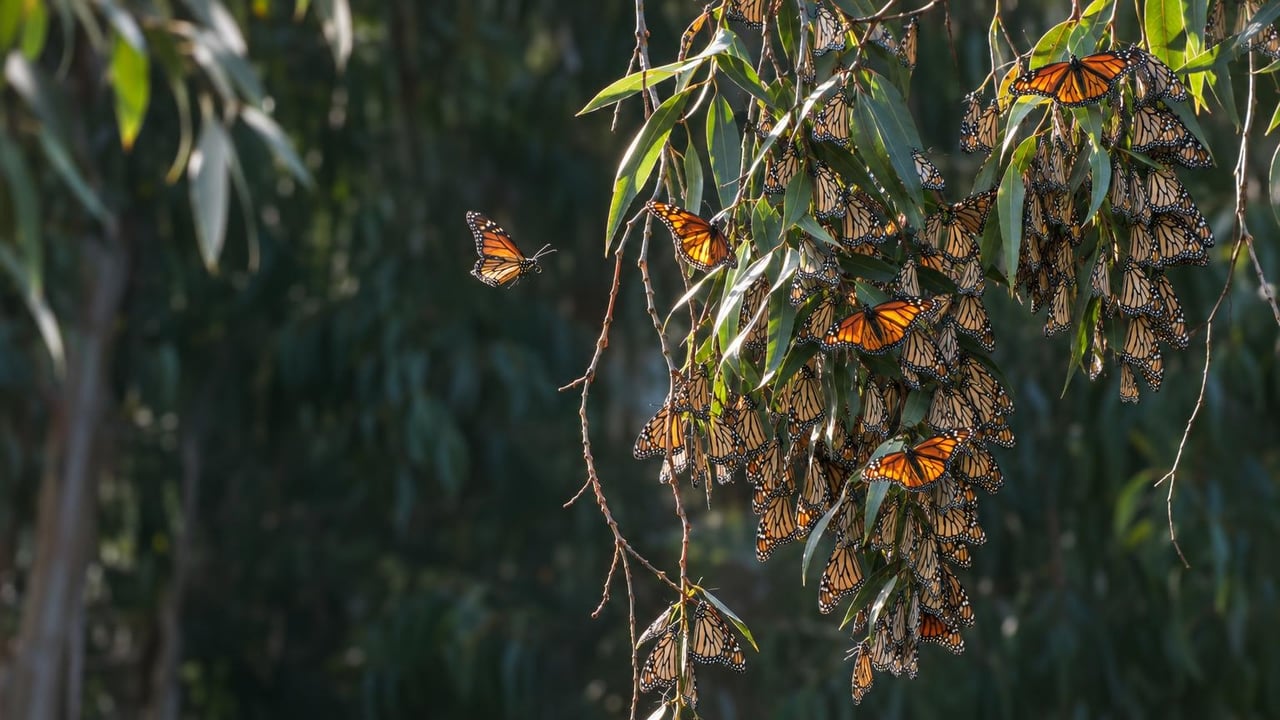
"See this big tall tree? The big thick one?" That's how Andrea McMahon, a volunteer at Natural Bridges State Beach, started pointing out a cluster to a visitor in a Lookout Santa Cruz story published this past Sunday. She traced a branch out to its tip, where something that looked like a clump of shriveled leaves hung. When the visitor looked closer, the clump turned out to be about 30 monarchs hanging upside down on one thin branch.
You can walk right past the monarchs at Natural Bridges without seeing them, and the weather decides what you'll see. If you're thinking about a walk on the Westside over Thanksgiving weekend, check the thermometer before you pick a time.
Two different visits in the same grove
At the grove, the number to watch is 55 degrees. Lily Aravanis, a State Parks interpreter at Natural Bridges, told Lookout that monarchs can't fly when it's colder than that, so your best chance of seeing them in the air is during the sunniest hours of the day. The park's own page says the butterflies huddle together in the eucalyptus on chilly days under 60 degrees.
So you can plan for one of two visits. The Xerces Society's visitor guide says to go on a sunny morning or afternoon above 55°F if you want to see monarchs fluttering, basking and flying around the grove. If you'd like to see the clusters, it suggests coming earlier, while the night's chill is still in the air, or on an overcast day. The same guide adds a fair warning. Clusters can be hard to find when nothing is moving to give them away.
Aravanis explained the problem in the same Lookout article: when monarchs rest in clusters they're so well camouflaged that "a lot of people go into the grove and they say, 'I didn't see any butterflies.'" She called the grove "a Goldilocks spot." It's close enough to the coast that it never freezes, the rings of trees block the wind, and an opening in the middle lets midday sun reach the butterflies. That opening is why a cold morning can turn into a busy grove once the sun gets high enough.
For a holiday weekend with guests in town, this gives you a plan. If the forecast is gray, go early and look for clusters, ideally with a volunteer helping you spot them. If the sun is out, wait until late morning or early afternoon and look up.
Where the numbers stand this week
McMahon told Lookout that there are about 1,400 butterflies at Natural Bridges "now," and that this is "probably good" given the trees the grove has lost. Last season gives you something to compare it to. Natural Bridges had 1,100 monarchs on October 29, 2025, early in that season, according to the Western Monarch Count. By early December 2025 the number had grown to 2,500, the highest count at any Santa Cruz County site that season, the Xerces Society reported in January.
Longtime docent Kirk Crane told KAZU in October about the grove decades ago: "We had 120,000 in 1997." Back then, he said, the trees were "roped with huge clusters the size of you and me." Statewide, the Western Monarch Count's mid-season total for late November through early December 2025 was about 12,260 monarchs across 249 sites, up from 9,119 in 2024. Both years rank among the three lowest totals since the count began.
Late November is also when the grove tends to fill in. A docent naturalist quoted by Visit Santa Cruz County said Natural Bridges usually sees its peak numbers in late November and early December. This weekend falls inside the Western Monarch Count's 2026 mid-season survey window, which runs November 14 through December 6. Natural Bridges and Lighthouse Field are both counted sites.
Getting into the grove at Natural Bridges
The Monarch Grove is part of Natural Bridges State Beach at 2531 West Cliff Drive. It's the only state monarch preserve in California. California State Parks lists park hours as 8 a.m. to sunset. From October 1 through January 31, the visitor center is open daily from 11 a.m. to 4 p.m. A wheelchair- and stroller-accessible boardwalk runs down to an observation deck in the eucalyptus, which makes the walk easy for grandparents and little ones visiting for the holiday.
Day-use parking is $10 for a regular vehicle, or $9 for drivers 62 and older. Xerces notes that free street parking nearby is another option. The park asks visitors to keep their voices down in the grove and not to touch or disturb the butterflies.
Docents are the most useful part of a cluster visit. The State Parks events calendar lists them in the grove daily from mid-October through December, 11 a.m. to 4 p.m., and says to call the park to confirm current numbers and whether docents are there. That window lines up with the warmer part of the day, so on a cool morning you may have the trail to yourself without anyone to help you spot clusters. If Thursday itself is your day, call before you go. The park posts daily hours, and with a holiday it's worth confirming.
Lighthouse Field, a little farther down West Cliff
You don't have to stop at Natural Bridges. Lighthouse Field State Beach is also on West Cliff Drive, and Xerces calls its Monterey cypress and eucalyptus grove one that usually hosts sizable displays of overwintering monarchs. Free parking is available in the paved lots along West Cliff and on nearby streets. State Parks lists the park as open 6 a.m. to sunset, with the parking lot open from 8 a.m. to sunset.
At Lighthouse Field, look toward the middle of the trees. The site management plan for the grove, based on monitoring from 2015 to 2017, places the core cluster in the center of the grove. Lighthouse Field had 979 monarchs on November 1, 2025, close to Natural Bridges' 1,100 a few days earlier. If Natural Bridges is busy with visitors over the long weekend, Lighthouse Field is a good second stop on the same stretch of coast. It works well with a walk along West Cliff, too.
Moran Lake, on the East Cliff side
For anyone on the Live Oak side of town, Moran Lake County Park at 22775 East Cliff Drive is open sunrise to sunset and has an ADA parking lot. The park's overwintering habitat includes eucalyptus groves inside the park and around the D.A. Porath/Lode Street Sanitation Facility.
If you haven't been in a while, the park looks different. According to Santa Cruz County Parks, crews trimmed trees on the lake's north and west banks in summer 2025 and removed the remaining eucalyptus at 40 Moran Way. That parcel was regraded in fall 2025, and native trees and shrubs are slated to go in this fall and winter after the rains. The Lode Street overwintering grove isn't slated for changes. In a Lookout commentary, the county parks director described the long-term goal as gradually replacing non-native blue gum eucalyptus with native species such as Monterey cypress and white alder.
Going early in the season this year
This winter is a reason not to wait. Rhiannon Sims of the State Parks Santa Cruz District told KAZU that monarchs choose groves partly for wind protection, "but if we have a big storm that comes through, sometimes even being in the grove isn't enough to protect them." Isis Howard, a conservation biologist with the Xerces Society, said in the same story that El Niño this winter could damage groves and kill more monarchs than in past seasons.
The monarchs usually stay at Natural Bridges until about Valentine's Day, when the park typically holds a festival to mark their migration. So there are months left to visit. Still, the peak weeks are right now, and a calm, dry weekend before the winter storms is a good time for your first trip of the season. If you like quieter trails beyond the coast, our recent post on the new Pace Trails at Quail Hollow covers a winter walk in the Sandhills, and our Santa Cruz neighborhood page has more on the Westside.
If you go this weekend, I'd love to hear whether you caught the clusters or the butterflies in flight. And if you ever want to talk about life on the Westside or anywhere else in Santa Cruz County, Hallie Anzalone is always glad to connect.